
📋 Table of Contents
📌 Read in :  Français (French)
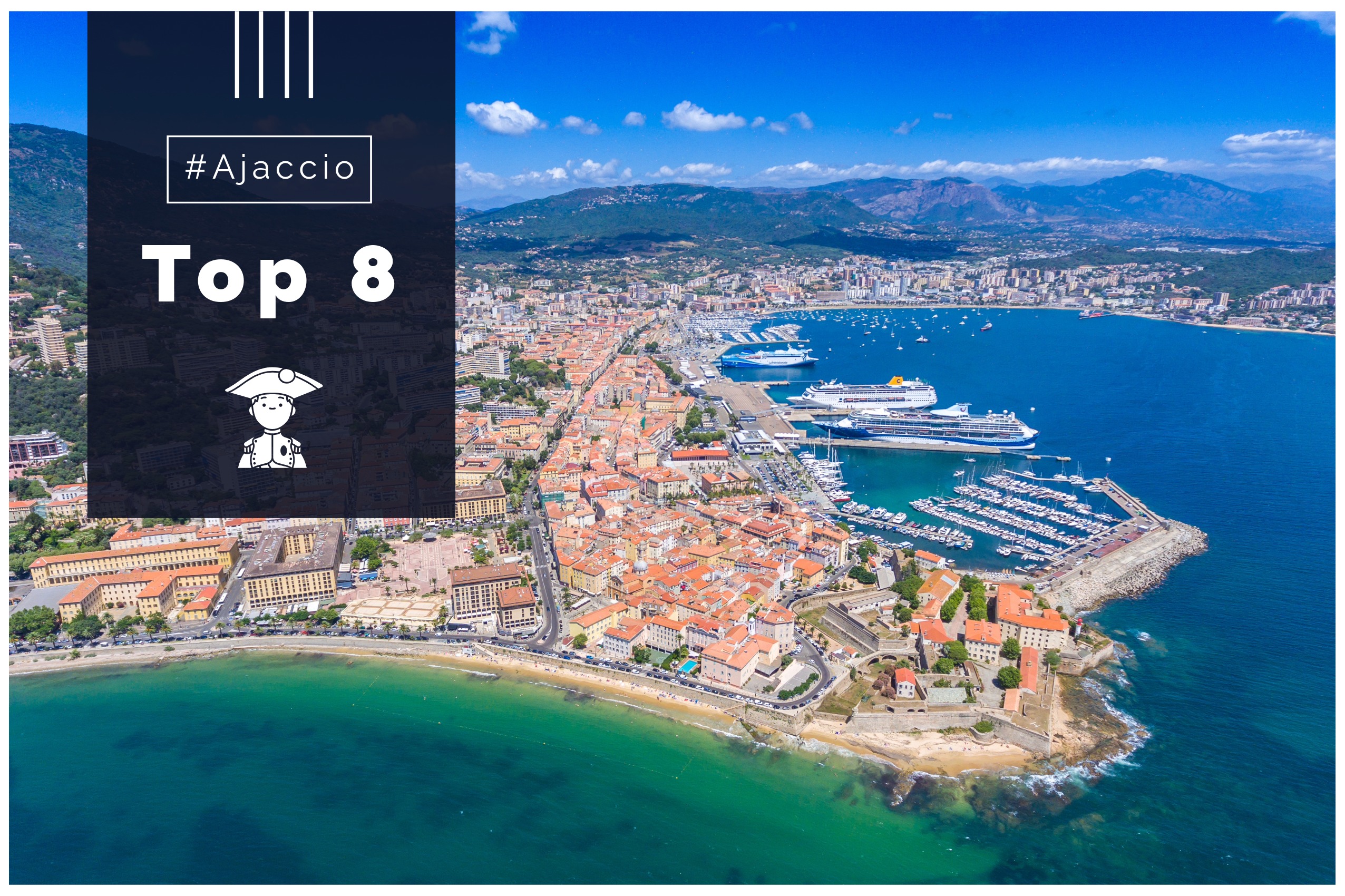
What to do in Ajaccio? Nestled between the sea and the mountains, the imperial city is more than just Napoleon or its sunsets over the Sanguinaires Islands, even though both are part of its identity. Ajaccio is a city best discovered on foot, wandering through its bright alleyways, shaded squares, fragrant markets, major museums, and with the seafront always within sight.

In just a few days, you can go from an imperial birthplace to one of the finest collections of Italian art in France, from a stroll to the Parata headland to a swim in a secluded cove, from a drink on the harbor to a trip to the beaches along the Route des Sanguinaires. Easygoing, bathed in sunlight almost year-round, and deeply attached to its lifestyle, Ajaccio is perfect for a Mediterranean city break. Here are its must-see attractions.
🗒️ Dates and hotels: what you need to know before visiting Ajaccio
Before we get into things to do in Ajaccio, here are some useful tips.
What is the best time to visit?
Ajaccio can be visited year-round, but the most pleasant time is from April to October. Spring is superb, with a distinctly Mediterranean light, a sea that is beginning to warm up, and hills still green. Summer guarantees swimming, long evenings, and al fresco living, but it is also the busiest season, especially in July and August.
September and early October often offer the best compromise: the water remains warm, the crowds thin out slightly, and the city takes on a more relaxed pace. In winter, Ajaccio retains its appeal thanks to its relatively mild climate, open museums, market, seaside promenades, and the quintessential Corsican contrast between snow in the mountains and sunlight over the gulf.
How many days should I plan for?
Two days are enough to get a good feel for the city: the historic center, the Bonaparte House, the Fesch Palace, the market, a walk to the citadel, and a sunset along the Route des Sanguinaires. Three days offer a much more complete experience, with time to add the cathedral, the Parata headland, an urban beach, or a mini-cruise.
With four days or more, you can adopt a more Ajaccio pace, alternating sightseeing and swimming, exploring the foreign quarter around Place d’Austerlitz, and enjoying the immediate hinterland. Ajaccio is well-suited to a long weekend, but also deserves a longer stay.
How to get around easily in Ajaccio?
Ajaccio’s city center is very walkable. The main sites in the historic heart of the city – Maison Bonaparte, the cathedral, Place Foch, the market, Palais Fesch, and the Tino Rossi port – are all close together. For reaching the more distant beaches, the Route des Sanguinaires, or the airport, buses are useful, although a car or taxi offers greater flexibility depending on the season.
There are also small tourist trains departing from Place Foch, convenient for a first visit, especially to the Sanguinaires Islands. If you plan to travel around a lot between the city center, beaches, and surrounding areas, it’s best to check the transport schedules in advance, as services vary depending on the time of year.
How do I get to the city center from the airport?
Napoleon Bonaparte Airport is located a short distance from the city center. By taxi or car, the journey is quick, traffic permitting. There are also bus connections depending on the season and schedule, particularly to the train and bus stations. It’s therefore a simple arrival, especially compared to other island destinations where transfers are longer. This proximity also explains why Ajaccio is so well-suited for a short stay: you can land, drop off your luggage, and start exploring the city center in no time.
Is there a useful pass for visiting the city?
Yes, the destination offers a City Pass for the Ajaccio region, available in several durations, which grants access to various sites and activities, sometimes with preferential rates on certain visits. It can be worthwhile if you want to combine several museums, a tourist train ride, or guided tours. For a very short stay, it’s best to calculate the cost based on your itinerary; for two or three intensive days, it can be a practical option.
Three hotels for a dream stay in Ajaccio
The Sofitel Golfe d’Ajaccio Thalassa Sea & Spa, located slightly outside the city center, is appealing thanks to its beachfront location, upscale retreat atmosphere, and highly regarded wellness area, perfect for a more seaside getaway. The Hotel Les Mouettes, housed in an elegant building with direct access to the sea, combines charm, stunning views of the gulf, and a more intimate ambiance, while remaining close to the city. The Hotel San Carlu Citadelle, in the historic center, provides a convenient base for exploring Ajaccio on foot, boasting a prime location between the old town, the port, and the citadel.
🔝 What are the must-see things to do in Ajaccio?
Now let’s get to the heart of the matter and see what there is to do in Ajaccio. Only the must-sees, of course.
Visit the Bonaparte House
It’s impossible to discover Ajaccio without stepping inside the Maison Bonaparte on Rue Saint-Charles in the old town. This is where Napoleon was born in 1769, and a visit allows you to move beyond the image of the great man and discover a family setting, almost a domestic one, that sheds light on his Corsican roots. The recreated rooms, the furniture, the portraits, and the objects tell the story of both Napoleon’s childhood and the rise of a family that profoundly marked European history. The place is nothing like a palace: that’s precisely what makes it so interesting. You can feel the density of the old city, the closeness of neighbors, and the daily life of a prominent Corsican family at the end of the 18th century.
The visit takes on its full meaning when then linked to the rest of the city. Upon leaving, it only takes a few minutes to walk to the cathedral where Napoleon was baptized, the shopping streets of the old town center, and Place Foch.

Discover the Palais Fesch and its Italian collection
The Palais Fesch, Museum of Fine Arts, is Ajaccio’s other major cultural attraction. Founded thanks to Cardinal Joseph Fesch, Napoleon’s maternal uncle, it houses a particularly rich collection of Italian art, often described as one of the most important in France after the Louvre. Even without being an expert, one is quickly struck by the quality of the rooms, the overall coherence of the collection, and the tranquility of the place. Religious paintings, portraits, works from the Italian school, and Napoleonic era: all combine to create a comprehensive and elegant visit that is both accessible and ambitious.
The museum also has the advantage of offering a welcome respite in the heart of the city, especially when it’s very hot. Its architecture, staircases, bright rooms, and neighboring imperial chapel give the whole complex a truly monumental grandeur.
Stroll through the old town and around the cathedral
Ajaccio is best enjoyed on foot, and nothing is more pleasant than strolling through its old town without a rigid itinerary. The narrow streets around the Santa Maria Assunta Cathedral, the ochre and pastel facades, the half-closed shutters, the small squares, and the shops give the imperial city an air that is both Mediterranean and almost Italian. The cathedral, relatively understated on the outside, offers a richer and more contemplative atmosphere inside. It is also a place steeped in history, as Napoleon was baptized there. The surrounding streets invite you to slow down, to observe the details, to step into a church, a shop, or a café.
Passing through Place Foch and the Ajaccio market
Place Foch, often called Place des Palmiers (Palm Tree Square), is one of those places that immediately sets the tone for a city. With its palm trees, lion fountain, statue of Napoleon as a Roman consul, and its lively atmosphere, it connects the old town to the shopping districts and the port. It’s also where much of the local life pulsates. Nearby, the Ajaccio market and the Halle Gourmande (Gourmet Market) offer a vibrant glimpse into the island’s gastronomy: cured meats, cheeses, fritters, bastelles (a type of Corsican pastry), Corsican wines, fish, essential oils, and seasonal products are all on display in an atmosphere far more authentic than a simple souvenir stop.
The market is particularly pleasant in the morning, when the locals come to do their shopping and the aromas of cheese, herbs, and pastries mingle under the already bright sunlight. It’s easy to put together a quick lunch there, then settle down on a bench in the square or stroll down to the seafront.
Go to the tip of Parata and admire the Sanguinaires Islands
If you could only keep one iconic natural postcard image of Ajaccio, it would be that of the Pointe de la Parata facing the Sanguinaires Islands. At the end of the Route des Sanguinaires, this spot offers one of the most beautiful panoramas in the gulf. The Genoese tower, the maquis shrubland, the dark rocks, the vast sea, and the jagged line of islets create a landscape that constantly changes with the time of day. It’s easy to see why so many writers and travelers have been captivated by this place. The sunset here is famous, but the point is worth visiting at any time, including early in the morning when the air is clearer.
The walk around the area is easy and accessible to most visitors. You can simply stroll around the point, climb up to the tower, sit facing the islets, or extend your visit with a swim at a nearby beach. In summer, the place attracts large crowds in the late afternoon, so it’s best to plan ahead or choose quieter times.
Take the Sanguinaires road and stop at the beaches
The Route des Sanguinaires is part of Ajaccio’s charm. It hugs the coastline, connecting the city to its most beautiful shores and revealing just how much Ajaccio is both urban and seaside. In just a few minutes from the center, you can reach a succession of beaches, small coves, and beach bars nestled against the deep blue sea. Some beaches are easily accessible and family-friendly, while others are more secluded. The pleasure lies precisely in moving at your own pace, taking in the views, stopping when the light is perfect, alternating between swimming and strolling, without necessarily trying to “tick off” a specific beach.
Discover the citadel and the seafront
Long closed to the public, the Ajaccio citadel is now one of the most interesting places to experience the city’s recent evolution. Built at the end of the 15th century, it overlooks the sea and serves as a reminder of Ajaccio’s strategic importance in Mediterranean history. While not all parts can be freely visited like a typical monument, the citadel area, its restored moats, the surrounding walkways, and the views of the coastline offer a true respite. It is a space where heritage, the sea, and contemporary uses are beginning to interact more effectively.
The seafront promenade, which extends this exploration, is also very pleasant. Between the Tino-Rossi port, the terraces, the strollers, and the late afternoon light, you rediscover a very Ajaccio-like gentleness. It’s a simple, almost obvious, but essential walk.
Head up towards Place d’Austerlitz and the Napoleon cave
Above the city center, Place d’Austerlitz and Napoleon’s Grotto offer another way to explore the imperial myth. Here, the Napoleonic narrative takes on a monumental scale: a large esplanade, a statue, inscriptions celebrating the battles, and a viewpoint overlooking the city. The famous grotto, where the young Bonaparte is said to have liked to retreat, is clearly more a part of the legend than a strictly historical site, but the whole area retains a certain charm. The climb also allows you to leave the bustle of the city center and reach a more open, airy location with a beautiful view of Ajaccio and the gulf.
The area is particularly pleasant in the early evening, when the heat subsides. You can walk there from the city center if you don’t mind the climb, or take the little tourist train, which often stops in the area. This visit isn’t essential if time is short, but it offers a different perspective of the city—more monumental, more symbolic—and complements the Maison Bonaparte nicely by showing how Ajaccio has gradually transformed the memory of its most famous son into an urban landscape.
So, we hope this small selection of things to do in Ajaccio has helped you plan your next stay in the Corsican capital.