
📋 Table of Contents
📌 Read in :
 Français (French)
What to do in Basel? Located at the crossroads of Switzerland, France, and Germany, Basel is one of those cities that is first discovered through its culture, then revealed through its atmosphere. People come for its world-class museums, starting with the Beyeler Foundation, the Kunstmuseum, and the Tinguely Museum. They stay for its steep old town, its striking red town hall, the banks of the Rhine, its motorless ferries, and that rare blend of Swiss precision, Rhineland charm, and contemporary creativity. The city lends itself equally well to a busy weekend or a more leisurely stay, punctuated by strolls along the riverbanks, relaxing on terraces, and lingering in the historic districts. Thanks to its manageable size, efficient public transport, and the BaselCard, which is offered in most accommodations, Basel is easy to explore. Here’s a helpful FAQ to help you plan your trip, followed by eight must-do experiences to discover the city.

🗒️ Dates and hotels: what you need to know before visiting Basel
Before we get into things to do in Basel, here are some useful tips.
What is the best time to visit?
Basel can be visited year-round, but the most pleasant time is generally from spring to early autumn. Between May and September, the Rhine quays, terraces, and squares of the old town come alive, and the long days allow for a combination of museum visits, walks, and urban swims. Spring offers a soft light on the historic facades and surrounding hills, while September often boasts mild weather with slightly fewer crowds.
Winter, on the other hand, gives the city a different personality: more subdued, more inward-looking, but very attractive, especially during the Christmas period, when the market set up in particular on Barfüsserplatz and Münsterplatz is considered one of the most beautiful in Switzerland.
How many days should I plan for?
Two days are enough to see the essentials of Basel: the old town, the Münster (minting museum), the Marktplatz (market square), a major museum, and a stroll along the Rhine. With three days, the trip becomes much more comprehensive, as you can add the Beyeler Foundation in Riehen, the Tinguely Museum, a ferry crossing of the river, and time spent in one of the large parks or at the zoo.
Four days or more allows you to explore the city at a slower pace, to vary the museums, to enjoy the Grossbasel and Kleinbasel districts more, or even to consider a cross-border excursion to Alsace or neighboring Germany, Basel being an excellent starting point for discovering the region.
How to get around the city easily?
Basel is best explored on foot, especially in the historic center, but one of its greatest assets remains its public transport network. Trams and buses provide quick access to all the major districts, museums, and even the Beyeler Foundation, located in Riehen.
For visitors staying overnight, the BaselCard is particularly appealing: it provides free public transport for the duration of their stay, including the initial journey to their hotel, and also offers discounts on numerous cultural and leisure activities. It’s one of the city’s best practical advantages, making getting around extremely easy and eliminating the need for a car.
How do I get to the city center from the airport?
Access to the city center from EuroAirport is easy. Bus 50 connects the airport directly to Basel SBB/CFF train station, from where you can easily reach the old town or other districts by tram, on foot, or via intercity transport. The journey is quick and very convenient, making Basel particularly easy to visit for a short break. This excellent transport connection also explains why the city functions so well on weekends, without significant travel time upon arrival.
Where to stay in Basel + three popular hotels
Staying in the old town or along the Rhine allows you to fully experience Basel’s atmosphere, especially in the evening when the streets empty and the riverbanks remain lively. The area around the train station is very convenient for quick arrivals and departures, while neighborhoods closer to the city center, such as the Kunstmuseum area or Barfüsserplatz, allow you to get around entirely on foot. Basel has an excellent tram network, so even a hotel located a little further out is generally very practical for sightseeing.
The Grand Hotel Les Trois Rois, on the banks of the Rhine, is the city’s iconic address, boasting a prestigious history, a prime location in the old town, and remarkable river views. Krafft Basel, on the opposite bank of the Rhine, charms with its elegant yet more relaxed style, its lovely terrace, and its ideal location for enjoying both Kleinbasel and Grossbasel. The Hotel Spalentor, near the medieval gate of the same name, is highly regarded for its comfort, welcoming atmosphere, and convenient location for quick access to the old town, the university, and several museums.
Is Basel an expensive destination?
As is often the case in Switzerland, Basel isn’t a budget destination, especially when it comes to accommodation and food. However, the city offers several advantages that make it easy to balance your budget: free travel with the BaselCard, numerous free walking trails, a very pleasant market and riverfront area without incurring any significant expense, and some museums that offer partial free entry or reduced rates. By planning your itinerary a little, you can therefore enjoy Basel without the cost becoming excessive for a Swiss city of this caliber.
What are the must-see things to do in Basel?
Now let’s get to the heart of the matter and see what there is to do in Basel. Only the must-sees, of course.
Explore the old town, the Marktplatz and the town hall
The best starting point for understanding Basel is its old town. A stroll often begins at the Marktplatz, dominated by the spectacular Rathaus, the red town hall adorned with murals, a true emblem of the city. The square is the hub of urban activity, with markets, trams, and that very particular feeling of an ancient city still fully alive. Walking up the cobbled streets, you pass through a dense urban fabric of patrician facades, passageways, small squares, and views of the Rhine. It is here that the continuity between medieval city, political power, and commercial prosperity is most clearly visible.
This neighborhood should not be “visited” in haste. It should be explored without a rigid plan, entering courtyards, looking up at the signs, following the alleyways that climb towards the Münster or slide down towards the river.

Go up to the Münster and enjoy the Pfalz terrace
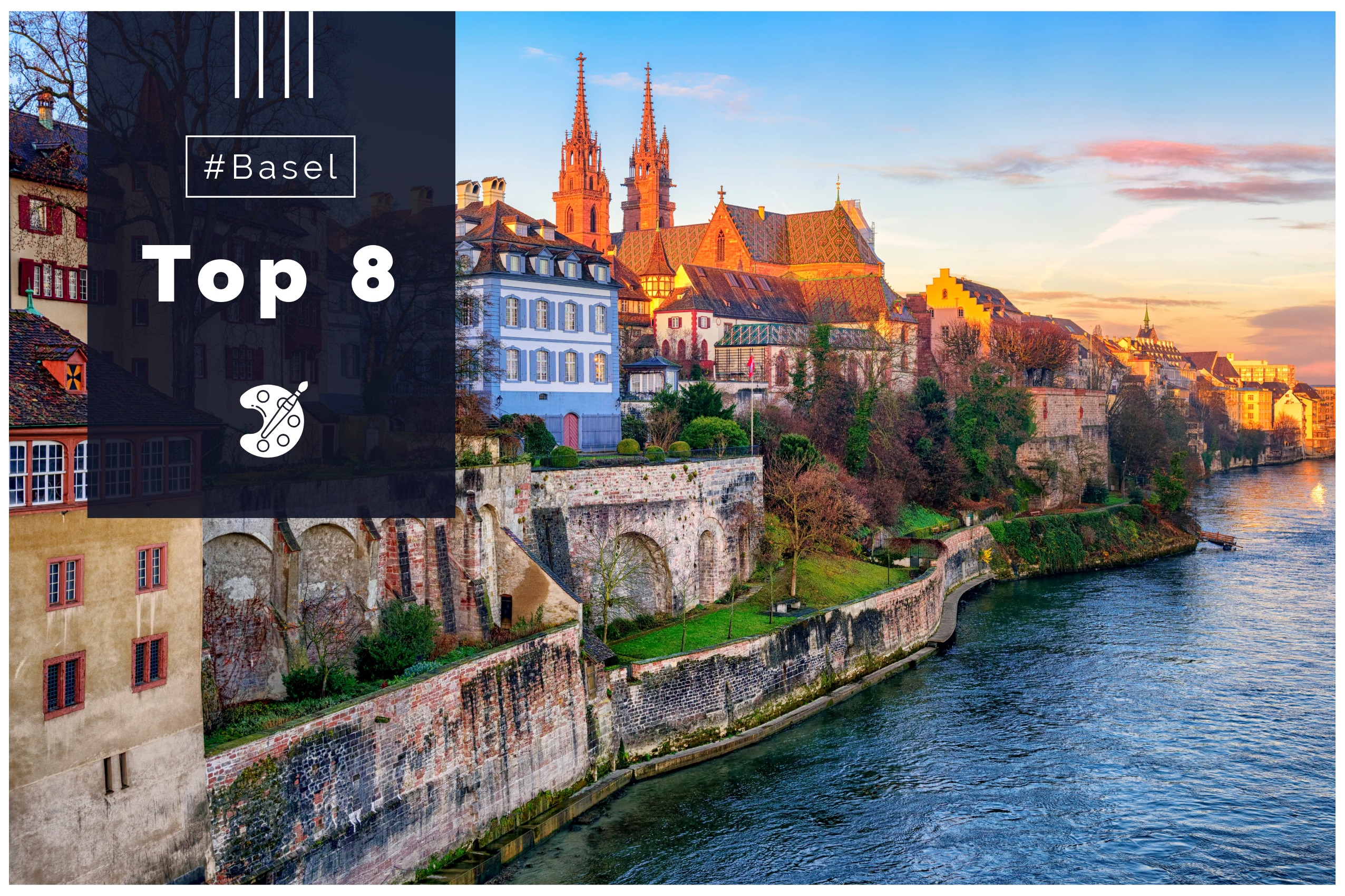
Basel Minster, a red sandstone cathedral with glazed roofs and two unequal towers, has dominated the Rhine for over eight centuries. Its silhouette is one of the city’s most iconic images. While going inside is essential to experiencing the atmosphere, admiring the cloister, the sculpted details, and Basel’s religious history, one of the great pleasures of the visit lies just beyond: the Pfalz Terrace. This viewpoint offers a splendid panorama of the river, the Mittlere Brücke (Middle Bridge), the rooftops of Kleinbasel (Little Basel), and the entire lower town. It is one of the most beautiful cityscapes in Switzerland.
A visit to the Münster also works very well as a starting point for a walk. Coming from the Marktplatz, you discover the city’s slope, then emerge onto this balcony overlooking the Rhine. In the morning, the light is very clear and precise; at the end of the day, the colors become warmer and the silhouettes stand out more clearly. For many visitors, the Palatinate (Pfalz) remains the place where Basel truly reveals itself.

Crossing the Rhine by ferry and walking along the quays
In Basel, the Rhine is more than just a backdrop: it shapes the city, its customs, and its atmosphere. One of the most enjoyable experiences is crossing it aboard one of the small, motorless Rhine ferries, propelled by the current and a taut cable. The journey is very short, but it has a timeless quality. You leave the riverbank in silence, watch the facades slowly drift by, see swimmers floating in the summer with their famous dry bags, and immediately understand the intimate relationship the inhabitants have with their river.
After crossing the river, continue your walk along the quays, either on the Grossbasel or Kleinbasel side, depending on your starting point. The riverbanks are perfect for strolling, taking a break, having a drink, or simply observing local life. In summer, it’s a veritable urban theater.

Visit the Beyeler Foundation
Just minutes from the city center, in Riehen, the Beyeler Foundation is one of Basel’s greatest cultural assets. Designed by Renzo Piano, the museum is as remarkable for its architecture as it is for its collection and exhibitions. The visitor experience extends beyond the artworks themselves: it encompasses the building, the lighting, the park, the pools, and the subtle interplay between art, nature, and space. Here, one discovers a major collection of modern and contemporary art, enriched each year by exceptional international exhibitions. Even for those unfamiliar with museums, this place is a must-see.
The journey to Riehen is straightforward by tram, and this excursion fits perfectly into a short stay in Basel. Allow at least two hours, longer if a major exhibition is on.

Enter the Kunstmuseum Basel
The Kunstmuseum Basel is the city’s other major art institution. Often described as one of the oldest and most important public art museums in the world, its collection spans a vast range, from Old Masters to modern art. Its strength lies not only in the quality of the works but also in the way they are presented: with clarity, restraint, and genuine intellectual ambition. The museum is now spread across several buildings, allowing visitors to experience different periods and atmospheres.

Discover the Tinguely Museum on the banks of the Rhine
The Tinguely Museum, housed on the banks of the Rhine in a building designed by Mario Botta, offers one of Basel’s most vibrant museum experiences. Dedicated to Jean Tinguely, it boasts the world’s largest collection devoted to the Swiss artist. Machines, kinetic sculptures, and sound installations create a far more playful and sensory visit than a traditional art museum. Here, one finds Tinguely’s characteristic spirit of play, mechanics, irony, and poetry, all within a delightful setting overlooking the river.
The museum is as valuable for its content as for its location. You can arrive by tram and then extend your visit with a stroll along the banks of the Rhine or a break at a café. It’s also a place that appeals greatly to visitors who sometimes feel less comfortable in traditional museums, precisely because it brings art to life and makes it very accessible.

Join Spalentor and the historic streets of Grossbasel
Among the most beautiful medieval gates in Switzerland, Spalentor is well worth a visit. With its side towers, colorful roofs, and almost surreal, almost theatrical appearance, it evokes the might of Basel’s ancient fortifications. But the appeal of this visit lies not only in the monument itself: it’s also an excellent way to discover other streets in Grossbasel, less crowded than the immediate area around the Marktplatz, but just as rich in historic facades, bookstores, small shops, and cafes.

Spending time at Basel Zoo
Basel Zoo, affectionately nicknamed “Zolli” by locals, is one of the city’s most beloved institutions. Founded in 1874, it’s not just a typical animal park, but a place deeply rooted in Basel life. A pleasure to visit, well integrated into the urban fabric, and thoughtfully designed, it appeals to families as well as visitors seeking a more relaxed experience between museums. A visit can last from two to several hours, depending on your interest in the different areas.
Its success stems from the quality of its facilities, the diversity of its animals, and its place in the local imagination. It’s a place many Basel residents visit regularly, and not just with children. For a multi-day stay, the zoo offers a welcome respite, especially if you combine heritage sites, art, and walks. It also reveals another side of Basel: a highly cultural city, certainly, but one that is also very attentive to major public facilities and the quality of leisure time.

There you have it! We hope this selection of things to do in Basel has helped you plan your Swiss trip. If you have any other suggestions, please don’t hesitate to contact us.