📋 Table of Contents
📌 Read in :
 Français (French)
Nestled in a bend of the Elbe River, Dresden blends Baroque splendor with alternative energy. Once nicknamed the “Florence of the Elbe,” the Saxon capital was virtually razed in February 1945 before rising from the ashes stone by stone: palaces, churches, and opera houses now stand alongside giant murals, microbreweries, and green spaces that stretch all the way to the impressive rock formations of Saxon Switzerland. A city of art and science, it boasts some of Europe’s greatest collections and a vibrant cultural scene that ranges from operas at the Semperoper to electronic music concerts in the Neustadt. Here’s what to do in Dresden for a short break.
🗒️ Time of year, hotels: what you need to know before visiting Dresden
Before we get into things to do in Dresden, here are some useful tips.
Where is Dresden?
Dresden occupies the heart of Saxony, in eastern Germany, 200 km from Berlin and 150 km from Prague, in a wide valley carved by the Elbe River. The city stretches along both banks: the Altstadt (Old Town ) to the south is home to Baroque monuments, while the Innere and Äußere Neustadt (Inner and Outer New Towns) to the north form a vibrant creative district. This central location on the Berlin-Prague axis explains its historical importance as a market town, arsenal, and princely residence, as well as the ease with which one can travel to the Meissen vineyards or the Saxon Switzerland National Park.
What is the best time to visit Dresden?
The climate is moderately continental: cool winters (average nighttime temperatures of 0°C) and mild summers (22–25°C). For a mix of sightseeing and river cruises, May-June or September are ideal : long days, festivals (Musikfestspiele), and manageable crowds. July and August are still pleasant, but busier; the heat is tempered by the Elbe breezes. Autumn offers vibrant colors along the wooded banks, while Advent brings the Striezelmarkt, the world’s oldest Christmas market, to life: 200 stalls, a 14-meter pyramid, and a Ferris wheel illuminate the Altmarkt square.
How to get to Dresden?
By train: the ICE connects Berlin (1 hour 50 minutes) and Frankfurt (4 hours); EuroCity trains serve Prague (2 hours 20 minutes).
By plane: Dresden International Airport (DRS) is 20 minutes from the centre; the S-Bahn S2 connects to the central station every 30 minutes.
By long-distance bus, FlixBus connects Munich or Hamburg in about six hours.
By car, the A4 (Aachen-Görlitz) and the A17 (towards Prague) encircle the city; large park-and-ride facilities limit traffic in the city centre.
Is Dresden expensive?
According to BudgetYourTrip data , a traveler spends an average of €67 per day on a budget (hostel, fast food), €158 for mid-range comfort (3-4 star hotel, traditional restaurants), and €335 for a luxury stay (palace hotel, daily shows). Major museums cost €10-14; the Dresden Museums Card (48 hours, €29) quickly offsets the cost if you plan several visits.
What events should not be missed?
- Dresden Music Festival (May-June): more than 60 concerts in the Frauenkirche, the Semperoper and the Kulturpalast, around the theme “Love”.
- Striezelmarkt (late November-December): 590th edition in 2024, with the world’s tallest Christmas pyramid and a giant gingerbread.
- Film Nights on the Elbe (July-August): open-air cinema and concerts on the riverbank opposite the Altstadt.
How to get around?
The city center is easily explored on foot. The DVB network (tram + bus + ferry) covers the entire city: a 90-minute ticket costs €3 or a day pass €8. A special tram, the “Schlösserlinie”, runs along the Elbe River to the castles of Loschwitz. Cyclists benefit from continuous cycle paths on both banks; the Elberadweg river route extends to Saxon Switzerland or Meissen.
What do people eat in Dresden?
Saxon cuisine blends Bohemian and Prussian influences: Sauerbraten (marinated roast beef), Quarkkäulchen (fresh cheese fritters), Eierschecke (three-layer cake), and, in season, Goldriesling or Federweißer white wine from the Radebeul hills. Don’t leave without trying Dresdner Stollen, a candied fruit brioche with Protected Geographical Indication (PGI) status, which can be enjoyed year-round in Pfunds or Wippler cafés.
How many days should I plan for?
Two days are enough for the Altstadt (Zwinger, Frauenkirche, Grünes Gewölbe) and a trip to the banks of the Elbe. Three or four days allow you to explore the Neustadt, take a paddle steamer cruise, or an excursion to Saxon Switzerland.
Where to stay in Dresden?
For a truly regal experience, check into the Hyperion Hotel Am Schloss, just steps from the castle: its 15th-century vaulted spa offers views of the Frauenkirche. If you dream of a historic palace, the Taschenbergpalais Kempinski (reopening in 2024) blends Baroque suites and gourmet restaurants in the former stables of Augustus the Strong. Travelers on a budget will appreciate the sleek design of the Motel One Dresden am Zwinger, located just behind the famous palace, with its shaded terrace and organic buffet.
🔝 What are the must-see things to do in Dresden?
Now let’s get to the heart of the matter and see what there is to do in Dresden. Only the must-sees, of course.
Marvel at the Zwinger, a masterpiece of Saxon Baroque
A true fantasy of Augustus the Strong, the Zwinger combines domed pavilions, festooned galleries, and fountain gardens around a vast ceremonial courtyard. Designed by Pöppelmann (1709-1732) for royal festivities, the complex now houses three major museums: the Gemäldegalerie Alte Meister (Raphael, Veronese, Canaletto), the Asian porcelain collection, and the collection of scientific instruments. Between rooms, open the glass doors to stroll along the flower-covered balustrades; from up there, you can appreciate the exuberance of the decor: smiling nymphs, mascarons, and gilded obelisks. Access to the gardens is free from 8 a.m. to 8 p.m., a perfect opportunity to experience the magic of the place at the first light of dawn.

Climb into the Frauenkirche, a symbol of Dresden’s renaissance
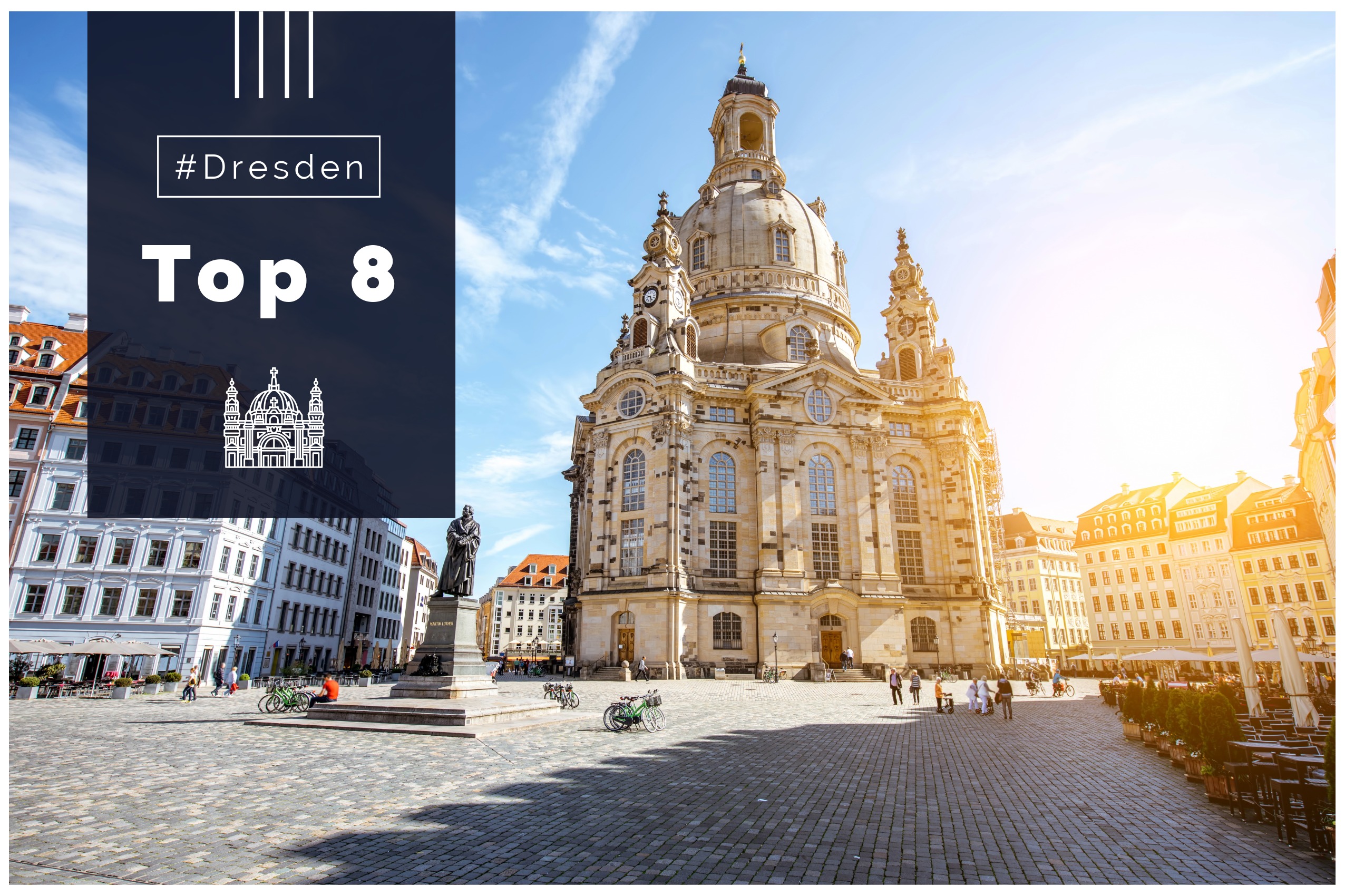
Destroyed in 1945, the Frauenkirche remained a pile of rubble for half a century before being rebuilt exactly as it had been and reopened in 2005. On Neumarkt Square, its golden sandstone dome rivals St. Paul’s Cathedral in London. Inside, pastel cupolas, a rococo altar, and a restored Hofmann organ create a luminous setting. A spiral staircase and then a metal walkway lead to the panoramic lantern: 67 meters above the cobblestones, the Old Town unfolds like a model, blending new light-colored stones with the original dark blocks—a poignant testament to the reconstruction.

Discover the behind-the-scenes of the Semperoper
A showcase of world music, the Semperoper (1878) enchants with its Italian Renaissance façade and foyers adorned with gilded stucco. If you’re not attending a performance, book a guided tour: crystal chandeliers, poppy-red velvet curtains, and royal boxes evoke the golden age of Saxon opera, when works by Wagner and Strauss were premiered. Acoustic anecdotes, secret passages, and fire curtains reveal the inner workings of the opera house; the tour concludes on the stage, facing 1,300 fan-shaped seats.

Admire the glittering treasures of the Grünes Gewölbe
In the royal palace, the Grünes Gewölbe (Green Vault) displays one of the richest treasury chambers in Europe. The tour is divided into the Historic Vault (eight restored Baroque rooms) and the New Green Vault, where some 3,000 objects vie for attention with their precious stones: the famous “Court of Augustus” in gold and emerald, the garnet flower set with 500 diamonds, and the 500 kg solid silver dinner service. Entry is timed, bags are prohibited, but the dazzling display of mirrors and gold makes this strict procedure well worthwhile.

Strolling on the terrace of Brühl, the “Balcony of Europe”
A former defensive bastion transformed into an aristocratic promenade, the Brühlsche Terrasse stretches for 500 meters between Castle Square and the Carolabrücke Bridge. Lined with the Academy of Fine Arts, the Albertinum, and the former Supreme Court, it overlooks the Elbe River from a height of about ten meters. Allegorical sculptures, stone benches, and majestic cedar trees invite contemplation; at sunset, the domes of the Frauenkirche and the Kunstakademie are tinged with pink, while paddle steamers raise their funnels for their final cruise. A romantic classic to be enjoyed at any time of day.

Explore the Neustadt: street art, microbreweries and nightlife
On the other side of the Elbe, the Äußere Neustadt is home to graphic design studios, vintage clothing stores, and craft beer bars. The pastel facades of Alaunstraße and Görlitzer Straße are covered in XXL murals, while the colorful courtyards of the Art Passage (Kunsthofpassage) transform the gutters into cascading musical waterfalls. In the evening, clubs like Groove Station and Katy’s Garage keep the crowds dancing until dawn in a decidedly alternative and friendly atmosphere—perfect for feeling the city’s student pulse.

Follow the Elbe river to the “Blaues Wunder” and the vineyards
Follow the cycle path along the right bank eastward: in just a few minutes, Art Nouveau villas, hanging gardens, and glass domes will pass by. In Loschwitz, the blue steel Blaues Wunder bridge (1893) spans the Elbe without a central pier, a remarkable feat of engineering for its time. From there, a historic funicular climbs to the castles of Oberloschwitz, and then the wine route winds its way to the terraces of Radebeul: a Goldriesling tasting or a riverboat trip along the hillsides completes this idyllic getaway.
Escape for a day to Saxon Switzerland and the Bastei Bridge
A 45-minute train ride (or 1 hour by car) away, Saxon Switzerland National Park unfolds with extraordinary sandstone spires. The most famous trail leads to the Bastei Bridge: a 76-meter stone bridge spanning soaring peaks 194 meters above the Elbe River. Spectacular viewpoints, the ruins of Neurathen Castle, and the picturesque villages of Rathen and Wehlen dot the loop (an easy 3-hour walk). Guided excursions from Dresden combine shuttle service, hiking, and lunch at a mountain inn—ideal for those without a car.

So, we hope this list of things to do in Dresden has helped you plan your trip to this German gem.