📋 Table of Contents
📌 Read in :
 Français (French)
Cork, located in the south of Ireland, is a city that stands firm. Resilient against time, Viking invasions, and nature’s unpredictability. However, it’s likely that you won’t be able to resist its beauty and the warmth of its residents. Cork is the country’s second-largest city after Dublin and has a deeply rooted maritime and trading history. Originally, the city was surrounded by two arms of the River Lee, and unsurprisingly, all of Cork’s must-see attractions are set along this river. Planning to visit Cork soon? Here’s what you should see and do (but, of course, the choice is yours).
💡 Did you know? The name ‘Cork’ originates from an Irish word meaning “marshy place”, referencing its initial location on the River Lee. It was here that in the 11th century, Saint Finbarr founded a monastery, which became the anchor for the city’s development.
🗒️ Travel timeline and key events: essential knowledge before visiting Cork
Before we delve into the must-dos in Cork, here are some travel tips.
How to get to Cork from Dublin?
There are several ways to get to Cork from Dublin:
- By train : Irish Rail (Iarnród Éireann) operates direct services between Heuston station in Dublin and Kent station in Cork. The trip usually takes about two and a half hours.
- By bus : Companies like Bus Éireann offer regular services between Dublin and Cork. The bus journey can take between 3 and 4 hours, depending on the road and traffic conditions.
- By car : Cork is 260 km from Dublin. If you hire a car you can take the M8 which is the direct motorway between the two towns. The journey by car usually takes between 2.5 and 3 hours, depending on traffic conditions.
When is the best time to visit Cork?
Much like most of Ireland, Cork enjoys an oceanic climate. The warmest months tend to be from June to August with average temperatures ranging from 15-20°C (yes, that’s as warm as it gets). This is also the peak tourist season. Spring (April-May) and Autumn (September-October) are less crowded and have relatively mild weather. Winters are cold and damp but seldom harsh.
What are the major cultural events of the year?
Cork undeniably boasts a rich cultural heritage in Ireland, hosting several significant festivals and events annually:
- The Cork International Film Festival : One of Ireland’s oldest film festivals, typically taking place in November.
- The Cork Jazz Festival : An annual event attracting internationally renowned jazz artists, usually celebrated on the last weekend of October.
- The Cork Midsummer Festival : An annual arts festival in June featuring a mix of theatre, music, dance, and visual arts.
Which hotels to choose in Cork?
Located near the River Lee, The River Lee Hotel offers a contemporary blend of elegance and comfort. Guests can enjoy scenic river views while being just a short walk from the main city attractions.
A bit more luxurious, Hayfield Manor is a 5-star hotel nestled in a serene setting but still close to Cork’s heart. Its impeccable service and intimate atmosphere make it a favoured choice for those seeking pampering during their stay.
Lastly, the Imperial Hotel on South Mall is steeped in history. As one of Cork’s oldest hotels, it retains its age-old charm while providing guests with all modern amenities. Its central location makes it an ideal choice for those keen to explore Cork on foot.
Booking.com🔝 The 9 must-do things to do in Cork
Here are some tips for you. Ready for the main content? Here’s what you should do in Cork for a memorable trip.
Stroll down St. Patrick’s Street
This is the main shopping street winding its way through the city centre. You’ll find numerous shops of all kinds. Locally known as “Pana”, it developed in the 1780s when Cork began expanding beyond its medieval walls. Its varied architecture reflects the city’s rich history. It’s also a popular meeting point for locals, near both the English Market (discussed below) and St. Patrick’s bridge.

Whet your appetite at the English Market
A key spot for any Cork visit, the English Market is right in the city heart. Best to visit before noon, especially if you’re a seafood lover. One of the world’s oldest municipal markets, it’s been operational since 1788! It’s the place to discover Irish local produce and interact with city residents.

Breathe fresh air in Fitzgerald Park
This peaceful haven in the city centre is best described as the Fitzgerald Park, a massive green area opened in 1902 for the International Exposition of Cork – named after the then-mayor, Edward Fitzgerald. This 5-hectare park boasts a café, several ponds, numerous sculptures and even a skate park. The Cork Public Museum (official site) and the quaint Daly’s Bridge, built in 1926, are also here.

Pray (or meditate) at St. Finbarr’s Cathedral
Though relatively modern, it’s no less grand than older religious buildings. Local limestone and marble, impressive stained-glass windows, and intricately crafted icons are features of St. Finbarr’s Cathedral (official site), completed in 1879. An older neoclassical building from 1735 was on the site but was replaced by the current structure. Only an entrance from that era remains. You can also see traces of an even older medieval cathedral.

Experience (pretend) confinement at City Gaol
One of Cork’s must-visit places, the City Gaol (official site) opened in 1824. Initially for men and women criminals in the city, it became a women-only prison in 1878, a status it kept for nearly 40 years. Later, men opposing the 1920 Anglo-Irish Treaty were imprisoned here. It closed in 1923 but opened as a tourist attraction in 1993, providing an insight into Ireland’s penal past.
Alternative: Spike Island. Often called the “Irish Alcatraz”, this Cork island has been a monastery, a fort, and a prison. The prison, closed in the late 19th century, was used during the Irish War of Independence. IRA prisoners were held here under British surveillance until 1938. Spike Island is accessible via tourist cruises from Cork harbour.

Take a pilgrimage to St. Anne’s Church
While Cork’s centre is beautiful, its outskirts are equally enticing. Visit St. Anne’s Church, an imposing religious building from 1722, located north of the city. Apart from its unique limestone and red sandstone walls, St. Anne’s, also known as Shandon Church and Bells, is famous for its over 32-metre tall bell tower housing eight historic bells. Visitors can ring the bells, observe the clock mechanism, and climb 132 steps for a panoramic city view. Entry is free, but there’s a €5 charge for the bell tower.
Admire Cobh’s hues
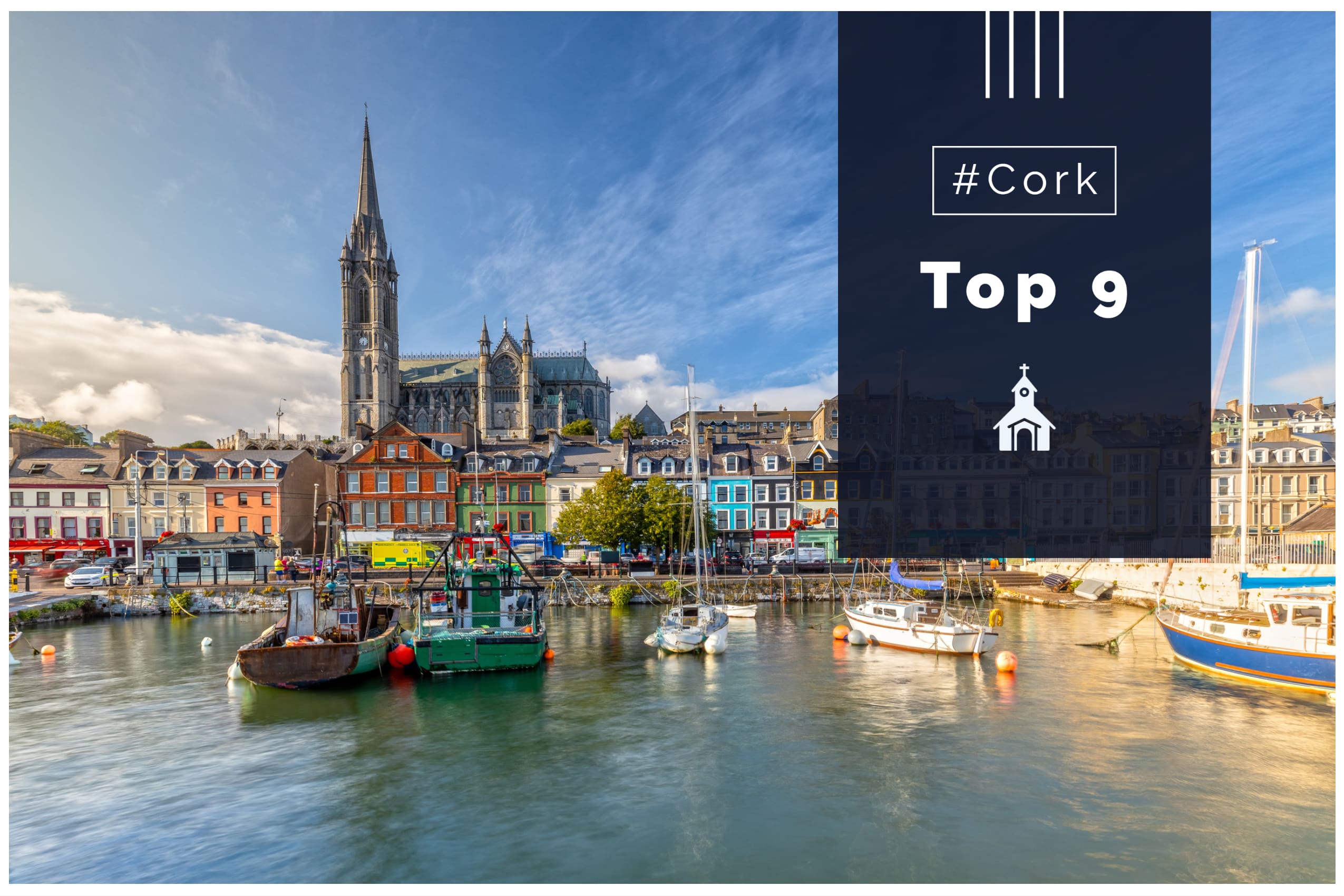
Granted, Cobh is known for being the Titanic’s last port of call in 1912. Still, it’s a favourite for cruise ships globally. This historic port, once named Queenstown and located 25 minutes southeast of Cork, offers plenty for visitors. Highlights include the magnificent St. Colman’s Cathedral from 1868 and charming coloured houses. Of course, the Titanic’s story is intertwined with Cobh, and you’ll find many guides to help relive it.

Refresh at Kinsale
Kinsale, about 30 kilometres south of Cork, is perfect for a nature break. Locals and foreign tourists frequent it for its colourful houses, dining options, and water activities. There’s also the Charles Fort, a fortress built in 1681 named after Charles II, the English king, offering spectacular and calming gulf views.
Master the art of eloquence at Blarney Castle
Not getting it? Let’s explain: northwest of Cork city lies the famed Blarney Castle. Within this splendid 15th-century castle is a stone. Legend has it that kissing this stone while upside-down grants the gift of eloquence. Intriguing, right? The Blarney Stone isn’t the only attraction: the castle is well-preserved, and its battlements offer breathtaking regional views.

That’s our list of Cork’s must-dos. Did we miss anything? Feel free to share in the comments.