📋 Table of Contents
📌 Read in :
 Français (French)
Madrid is a truly captivating city – and one of the most pedestrian-friendly in Europe, too. Its rich heritage, vibrant cultural scene, and lively nightlife make it a perfect destination for escaping the everyday. But if you have several days to spare, perhaps you’d like to venture beyond the city limits and explore its beautiful surrounding region? In this article, we’ll explore what to do around Madrid, revealing 10 destinations located less than 2.5 hours away by public transport from the Spanish capital. Let’s go, from Toledo to Siguenza, for a truly memorable journey.
🗺️ Visit only the best of Madrid. If you have limited time to explore the Spanish capital, read
our selection of must-sees.
The Royal Monastery of El Escorial

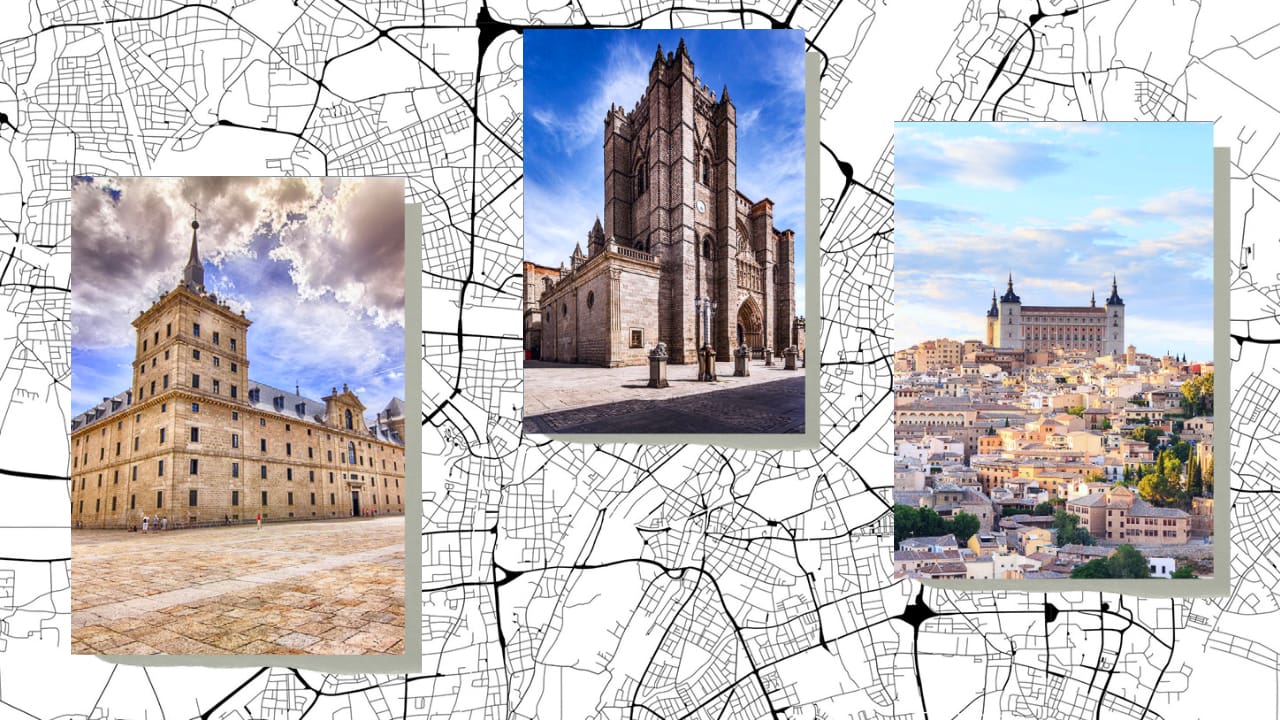
What to do around Madrid? Here is our first idea. The Royal Site of San Lorenzo de El Escorial is a large complex – including a monastery and a splendid palace – which is located in the municipality of San Lorenzo de El Escorial (in Spanish), 45 kilometres northwest of Madrid.
Why visit the Escorial Monastery
The Escorial monastery was built at the end of the 16th century, its design echoing the shape of a gridiron, an instrument inextricably linked to the martyrdom of Saint Lawrence. This building is far removed from the architectural restraint typical of the period, but its style influenced many other monuments and palaces after its construction. It has served as the pantheon of Spanish monarchs since Charles V, Holy Roman Emperor.
How to get from Madrid to the Escorial Monastery
By train, it’s quite simple; just take the commuter train, line C3. Trains start running early in the morning, between 5 and 6 a.m., and stop around midnight. Check your timetable here. The journey from Madrid to El Escorial takes about an hour.
The Sierra de Guadarrama National Park

Among the places to visit around Madrid is the Sierra de Guadarrama National Park, located in the autonomous communities of Castile and León and the capital. It is situated about sixty kilometres north of the capital.
Why visit the Sierra de Guadarrama National Park
This national park, established only recently in 2013, boasts the only Iberian examples of “high Mediterranean mountains.” It is home to 1,500 native plants and 30 different types of vegetation. Animal species inhabiting the mountains represent 45% of Spain’s total fauna, highlighting the area’s precious nature. Spending a day here, strolling through its lush landscapes, will be an unforgettable highlight of your Madrid getaway.
How to get from Madrid to the Sierra de Guadarrama National Park
To get from the centre of Madrid to the Sierra de Guadarrama park, if you don’t have a car, the best option is to go to the Moncloa bus station, where buses will take you to your destination in less than two hours.
Manzanares el Real Castle

We remain in the Sierra de Guadarrama region. Also known as Los Mendoza Castle, this palace-fortress was erected in the 15th century in the town of Manzanares el Real (Community of Madrid).
Why visit Manzanares el Real Castle
It is one of the best-preserved castles in the region. Its construction began in 1475 on the site of a Romanesque-Mudéja hermitage, eventually becoming the residential palace of the House of Mendoza. With its imposing ramparts, flanked by majestic towers, the building attracts many tourists, who can also enjoy a museum—dedicated to Spanish castles—as well as a tapestry exhibition.
How to get from Madrid to Manzanares el Real Castle
To reach the castle from the centre of Madrid, without a car, you have to go to the Plaza Castilla bus station, and take lines 720 and 724.
Coca Castle

We move even further northwest of Madrid to this magnificent castle, located in the province of Segovia, and considered a major work of Spanish Mudéjar Gothic.
Why visit Coca Castle
The unique feature of this fortress is that it is built on a slope, rather than a rocky promontory, as is often the case. A second advantage is its exceptionally well-preserved state. The work of master builders from Seville, the structure was built in the 15th century, primarily using brick. Brick is found both as a foundation material and as a decorative element. Many rooms, as well as the ramparts, are open to the public.
How to get from Madrid to Coca Castle
Getting there from Madrid is a bit complicated. However, you’ll find quite a few excursions departing from the Spanish capital. Alternatively, take the train to Segovia; the options there should be cheaper. Buses also get there in under an hour.
Toledo

Thanks to its flamboyant past, which has left beautiful traces in its architecture, Toledo has become an important tourist centre in Spain. And its appeal has been further enhanced since its inscription as a UNESCO World Heritage Site.
Why visit Toledo?
This city has seen three religions coexist: Christianity, Islam, and Judaism. Naturally, this has left its mark. The imperial city boasts numerous monuments, each more impressive than the last. Its viewpoints, the Alcázar, the Alcántara Bridge, its maze of narrow streets, the thousand-year-old Cristo de la Luz Mosque, the Santa María la Blanca and Tránsito Synagogues, and of course, its cathedral… Everything in Toledo is worth a visit. And the city isn’t that far from Madrid.
How to get from Madrid to Toledo
Getting from Madrid to Toledo is simpler than the previous journeys. The easiest way is to take the AVE, Spain’s equivalent of the TGV, which will get you there in under 30 minutes for around ten euros. If you prefer the bus – which is cheaper – head to the bus station at Plaza Elíptica. The journey takes just under an hour.
🛎️ Water and a beautiful view of Madrid? It’s possible. Have a look at our selection of hotels with rooftop pools, right in the heart of the Spanish capital.
Segovia

What to do around Madrid? Go to Segovia, of course! It’s the major city in the northwest of the capital. If you don’t have time to go all the way to the Sierra de Guadarrama National Park or the Manzanares el Real Castle further north, at least take the time to discover this magnificent city.
Why visit Segovia
Here’s a city listed as a UNESCO World Heritage Site, located not far from Madrid, and which can be visited in a day (for its main monuments)… What more could you ask for? Of course, a visit to its famous aqueduct is a must. But also to its Jewish quarter, which you reach by passing the Church of San Martín and the Casa de los Picos, with its façade entirely covered in granite blocks cut into diamond points. For lovers of beautiful panoramas, a stop at the Alcázar and its immense 150-meter tower is essential. In short, as you’ve probably gathered, Segovia is well worth the trip.
How to get from Madrid to Segovia
Segovia is about 60 kilometres from Madrid. The AVE, the Spanish high-speed train, will get you there in just half an hour. One slight drawback is that Segovia’s train station, which serves these trains, is a bit far from the city centre. You can also opt for a regional train, which is slower but also cheaper (7 euros compared to at least 12 for the AVE). This train departs from Chamartín station in Madrid. For those on a tight budget, there’s always the bus: it leaves from Moncloa station in the capital.
Alarcón

This time, we’re heading southeast of Madrid. Alarcon is a small town located halfway between the capital and Valencia, and is also classified as a historical site in Spain.
Why visit Alarcón
This small town will transport you back in time. Alarcón was a privileged witness to the Spanish Reconquista, its keep having withstood the test of time. Nestled in the Júcar River gorge, it’s the perfect spot for a day trip, especially since the surrounding area also offers lovely walks. Its historic town center, conveniently located between the Cañavate and Alarconcillos towers, is also well worth exploring. And of course, a visit to the Plaza del Infante Don Juan Manuel is a must, as it’s where the main monuments are located.
How to get from Madrid to Alarcón
We’ll be honest with you now: if you’re planning a day trip from Madrid to Alarcón, it’s best to rent a car. The journey will take between 1.5 and 2 hours. Public transport will obviously take longer. The best option is to take a train to Cuenca and then a bus. But that will take at least 3.5 hours…
Siguenza

Located in the north of the province of Guadalajara, northeast of Madrid, Siguenza has a very well preserved historic center which has been classified as a national heritage site since 1965.
Why visit Siguenza
Here again, when it comes to historical remains, you’ll be spoiled for choice. Siguenza boasts a number of remarkable buildings, starting with its castle, built after the Arab invasion in the 8th century, along with its city walls. Its cathedral, built in the early 12th century and blending Romanesque and Gothic styles, is also particularly splendid, with its imposing rose window. Given the number of things to see in Siguenza, plan a full day for your visit. For hiking enthusiasts, the Dulce River Ravine Park is nearby.
How to get from Madrid to Siguenza
It’s quite easy to get from Madrid to Siguenza by train. A regional line will take you there in 1 hour and 30 minutes for around twelve euros. There are about seven trains making the round trip each day. But if you want a truly magical getaway, there’s… a medieval train! Yes, you read that right. A journey during which you’ll encounter jugglers and troubadours, accompanied by medieval music, plus a guided walking tour of Siguenza. All for around forty euros per adult.
Burgo de Osma

What to see around Madrid? Burgo de Osma seems like an obvious choice. This town in the province of Castile and León, a splendid vestige of the Visigothic era and the post-Arab invasion period, is located north of Madrid. It may be the furthest destination from the capital that we suggest, but its splendour is well worth the distance.
Why visit Burgo de Osma
Here is yet another Spanish city that has managed to weather the centuries, retaining only its best. People go there, in particular, for its unmissable cathedral, built in the 13th century in the Gothic style. Its nearby episcopal palace is also worth a visit, as are its main street (Calle Mayor) and the main square, surrounded by beautiful arcades. As you will have gathered, visiting Burgo de Osma is like stepping back into the Middle Ages. Its walls, the Santa Catalina University, and Osma Castle will constantly remind you of this.
How to get from Madrid to Burgo de Osma
If you don’t have a car, the bus remains the most economical and direct way to get to Burgo de Osma. The journey takes at least 2.5 hours, so it’s best to leave early and return late. Alternatively, you could consider spending a night there, especially since there are plenty of places of interest in the area, such as the Cañón del Río Lobos (a natural park) or the beautiful city of Almazán.
Avila

To conclude this selection of what you can do around Madrid, head to Avila, in the hilly northwest of the Spanish capital.
Why visit Avila
Few cities in Europe boast walls as majestic as those of Ávila. Walls flanked by no fewer than 88 towers and pierced by nine gates! But you would be wrong to limit yourself to the city walls alone. Ávila has many other treasures, notably its cathedral, the first built in Spain in the Gothic style. Other religious buildings are also worth a visit, such as the Santa Convent, built on the site of the birthplace of Saint Teresa, a 16th-century figure inextricably linked to the history of Ávila – and whose spirit will accompany you throughout your visit.
How to get from Madrid to Avila
It’s possible to travel from Madrid to Avila by train. The journey takes about two hours and costs around ten euros. That’s an average; you can find even cheaper tickets. The bus is only slightly faster (1 hour 45 minutes) for a similar price.
So, we hope you now know what to do around Madrid. Over time, we’ll, of course, add other destinations. Spain has no shortage of treasures!